


10 Toy Photography Ideas to Spark Your Creativity
I think most creatives have, at some point in their career or hobby, experienced creative block, and it's a horrible feeling. Being unable to think of new toy photography ideas always sent me into a bit of a pit, especially after photographing so many different scenes. It sometimes feels like you're just regurgitating old ideas.
Personally, I've had times where I've almost lost my love of the hobby because of it, though thankfully it's mostly been short-lived. I eventually started compiling a list of ideas for when my brain wouldn't function but I still had the itch to be creative. And now I've condensed those ideas into ten topics that can hopefully help you too.
Toy Photography Ideas & Topics
For convenience, you can click straight to each section here:
1. Toy Photography in Woodland Scenes
Probably the easiest place to start – and, for me, one of the most grounding – is to chuck a few toys in a rucksack, head to the woods and see what you stumble across.
Toy photography is all about noticing the finer details, and woodland is full of tiny little scenes that most of us walk straight past. A patch of moss can become a field, a fallen branch can become a bridge, and a mushroom suddenly looks enormous when you're viewing it from the perspective of a little figure.
You don't necessarily need to go out with a photograph already planned, either. Sometimes it's more fun to find the location first and work out what your figures could be doing there.
"Simplicity is the ultimate sophistication" - Leonardo Da Vinci
I also find that if I'm having a creative block, I still come away with a photo I'm happy with. It takes away the feeling of needing to try too hard with miniature props or dioramas. Keep it simple: have your figure balancing across a stick, looking up at a flower or mushroom, hiding amongst the leaves or simply wandering through a tiny field of moss.

The woods also offer the perfect opportunity to experiment with making your toys look life-sized. It's much easier to find plants or rocks that feel believable at their scale, and even things like sticks can be used as trees in the backdrop.
Ideas to try:
Balance a figure on a fallen stick as if they're crossing a bridge
Give your figure a tiny walking stick and send them hiking through a field of moss
Sit them on a branch admiring the view
Have them fishing from the edge of a pond or stream
Use small branches as full-sized trees to create their own miniature woodland
Give your figure a large leaf to use as an umbrella – My Neighbour Totoro style
Make miniature autumn leaves and have your figure jumping in or throwing around a leaf pile
Use a mushroom as a giant shelter, seat or meeting place
2. Make Miniature Versions of Your Hobbies
I love making miniatures, especially because the process itself usually gives me new ideas for photographs. They can also really help sell the illusion that your figures are life-sized.
You don't need to be particularly good at making miniatures, either. Half the fun is figuring out how to make something recognisable when it's only a couple of centimetres tall. I also have a few articles that may help if you are looking to make your own miniatures.

Over the years I've made miniature Pokémon cards, books, game consoles, toy boxes and all sorts of other things based on my own hobbies. Most are relativity easy to make – especially if it only needs some paper and a printer – but I also highly recommend using Fimo if you want to make anything a bit more solid.
Ideas to try:
Miniature gaming set up
Playing a sport
Tiny scrapbooking
Gardening or small allotment
Tiny Pokémon card collecting
Painting or drawing
Make them their own camera
Cooking (pumpkin carving, easter egg painting or Christmas cookie making if you're after seasonal ideas)
3. Water & Reflections
I'm super biased, I know, but I will always encourage people to go out and find some water to experiment with. One of my favourite props is a little boat, and all you need is a shallow bit of water for it to work really well. It's one of those props I always keep in my bag, just in case I stumble across the perfect spot.
If you haven't experimented much with reflections before, start simple. Put your figure beside a puddle, get the camera nice and low, and see how much of the reflection you can bring into the frame. I've written a whole guide to toy photography with water and reflections if you want to experiment with it a little more.
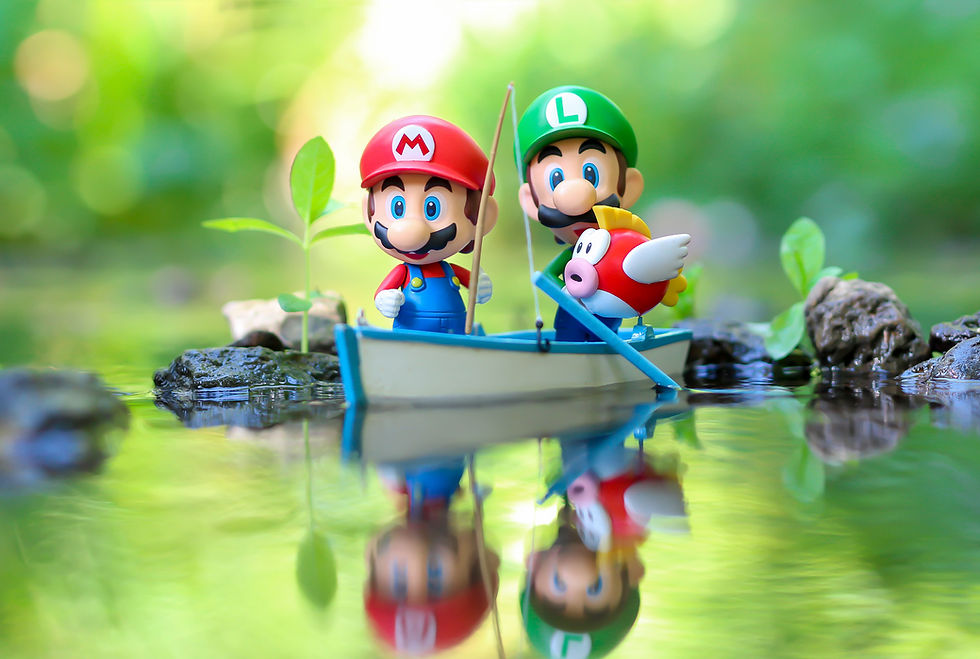
You don't necessarily need water, either. Mirrors, windows, shiny surfaces and even phone screens can create some really interesting reflections, giving you another way to play around with your composition.
Ideas to try:
Use a watering can for rain
Find a size appropriate boat
Fishing
Stepping stones
Use a mirror as a portal
Use glass to look like you're shooting through a coffee shop window
Summer poolside scene
Bridge over a lake
4. Night & Darkly Lit Toy Photography
I avoided night shots like the plague when I first started toy photography. Partly because I didn't really know what settings to use, but mostly because I had absolutely no idea what to photograph once it got dark.
Eventually, though, I realised that darkness actually gives you a lot to play with. You have much more control over where the light comes from, what you choose to reveal and what you leave hidden. A small torch, LED light or even the screen of your phone can be enough to light a figure, while everything around it disappears into shadow.
It's also a really easy way to completely change the mood of a location you've photographed a hundred times before. A woodland scene that feels quite wholesome during the day can suddenly look a little sinister at night, while street lights, fairy lights and other little points of light in the background can add a bit more magic to an otherwise ordinary location.
Best of all, you don't even need to wait for it to get dark. Set up a scene in a dark room, leave your camera on a tripod and experiment with different lighting setups. It's a good excuse to play around with ideas without having to worry about finding the perfect location.

Ideas to try:
Size appropriate street lights
Lit up in the headlights of a car
Create a moonlit scene
Inside a spaceship
Light up a figure sat under a duvet playing a Gameboy or reading a book
Carrying a candle through a haunted house or creating a séance
Exploring tunnels with a lantern
5. Action Photography Using Fire and Explosions
You really don't have to go out and buy fireworks and blow up your garden to achieve this. That being said, some photographers have seriously mastered the explosion shot, and I'm always mega impressed to see it done so well with actual fireworks.
Sparklers are a great way to create the look of fireworks in the background of a shot. They're inexpensive, and because they burn for a little while, you've got some time to experiment with your composition and get the shot you're after.
This is one area where it's becoming increasingly easy to turn to AI instead, whether that's adding fire, explosions or an entirely new background. Personally, I think that's a bit of a shame. So much of what I enjoy about toy photography is figuring out how to create these effects for real – experimenting, getting things wrong and occasionally stumbling across something that works far better than expected.
There are wider conversations to be had around AI and the ethics of the imagery used to train it, but even putting those aside, I think something gets lost when we remove the problem-solving from a creative hobby. Plus, I think we can all agree that the real thing just looks badass.

Ideas to try:
Bonfire
Fireworks
Battle scene
Magic & spells
Welding a miniature car
Long-exposure light trails
6. Special Effects
I split this from action photography because I'm talking more about effects created in post, rather than things happening in-camera like sparks or explosions. If editing isn't something you're particularly confident with, this can be a really fun way to improve your skills.
I never used to go overboard with edits, mainly because I used to hear a lot of “you're not a real photographer if you edit too much”. At some point, though, I realised that toy photography isn't just photography – it's art. If you're enjoying the process and creating something you're proud of, that's what matters most.
Once I got past that, I started having a lot more fun with Photoshop. I experimented with glowing effects, drawing over the top of photographs and adding things that would be difficult to create practically, like a Patronus coming from a wizard's wand or making flowers and insects glow.
Weirdly, that experimentation also made me better behind the camera. Working out how light needed to fall in the original photograph so that an effect would look believable later pushed me to think much more carefully about lighting, exposure and atmosphere.
It's another reason I find the rise of AI in creative work a little sad. For me, a huge part of the satisfaction comes from learning how to create an effect yourself, whether that's in-camera or in post. There’s a sense of achievement when you finally make something work exactly how you imagined it.

Ideas to try:
Patronus from a wizards wand
Glowing fields of flowers or mushrooms
Add Anime/Manga expression symbols
Add glowing fairies or fireflies
Use text scenes from video games (like the Pokémon battle scene text)
7. Recreate a Movie or Gaming Scene
I'm a hardcore Stephen King fan, so when October falls, I love creating spooky shots based off my favourite books. This is probably the easiest way to get inspiration, especially when there are so many games, films, TV shows and books to pull ideas from.
You don't necessarily need to recreate a scene, either. Sometimes it's more fun to take the general idea, lighting or atmosphere and make your own version of it. Like recreating an iconic movie poster or just building a location from a game. I love creating mash-ups between different worlds – throwing Zelda and Mario together, for example, to create something a bit different.
If you're completely stuck for ideas, go back to something you already love. Pick a favourite film, game or book and think about what makes it instantly recognisable; a location, an object, a colour, a character or even just the atmosphere.

Ideas to try:
Horror Movie Scenes (Jack or the twins from The Shining, the Scream Mask, etc)
Anime, Studio Ghibli or Disney scenes
Video Game scene (the Pokémon battle scene or coocoo's chasing Link)
Recreate iconic rooms from sitcoms (the Friends apartment)
Recreate a movie poster or book cover
Mash up different fictional universes
8. Levitating Toy Photography
I love, love, love levitation shots. They're a great way to add motion or storytelling to an image, and they're nowhere near as difficult to create as you might think.
"You'll float, too" - Pennywise, IT
I use levitation quite a lot in my profession as a watch photographer, too, and over the years it's become one of my favourite ways to photograph them. There's something really satisfying about making an everyday object appear to float, especially when it leaves people wondering how the shot was put together.
I've found that figure stands or wire work best for holding things in place, then I simply remove the supports afterwards in Photoshop. Once you get used to doing it, you stop worrying about how much wire is actually in the shot and can just have more fun with the setup.
Also, levitation doesn't have to mean superheroes flying through the air. You can have books floating around a character, Pokémon hovering above the ground, objects flying across a room or even something as simple as a figure suspended slightly above the floor. Sometimes making one thing behave in a way it shouldn't is enough to make an otherwise ordinary scene much more interesting.

Ideas to try:
Floating on the moon or in space
Flying
Falling from a height
Floating away with a bunch of balloons
Witch on a broomstick
Mid jump over stepping stones or away from an explosion
Have items magically floating around your character
Suspend falling leaves for an autumnal scene
9. Flat Lays & Birdseye View
Flat lays are iconic in the world of photography, there's something just so aesthetically pleasing about them. You tend to loose the depth that toy photography seems to thrive from, but it doesn't mean you can't get some creative shots.
This style additionally taught me a lot about composition. Rather than relying on the depth of field, I was forcing myself to arrange everything on one plane, where I just took the time to mess around with patterns and colours.
You don't have to keep it all neat and tidy. Like below where I placed a Nendoroid on top of a mound of Pokémon, you can simply have your figure lie amongst items related to them. These kind of shots work particularly well when you have a story behind why you're looking down. A figure lying exhausted on the floor, floating in waters, making snow angels, or surrounded by some disaster.
Sometimes you've exhausted so many ideas that just taking a different perspective is enough to spark some creativity.

Ideas to try:
Lying on the floor in a food coma
Have your toy asleep somewhere cosy
Birdseye view of a family meal, toys around the table with the table covered in food
A coffin with a vampire inside
A battlefield of a character injured on the ground, weapons scattered around them
Floating in water
figures lay together watching the clouds
Creating snow angels
10. Flat Lays & Birdseye View
Putting toys into real-world environments might not give you that life-sized illusion, but it can make for some really fun The Borrowers-style shots. If you've never seen the film, I highly recommend it – or Studio Ghibli's Arrietty for even more miniature inspiration.
Of course, this doesn't just apply to food. Have your figures sliding down the banister, climbing through a houseplant or finding other ways to interact with everyday objects around your home. Sometimes deliberately embracing how tiny they are can be much more fun than trying to hide it.
Food is particularly good for this because it naturally exaggerates that sense of scale, while also adding plenty of colour to the scene. Have your figures stealing biscuits, climbing over fruit, sitting beside an enormous slice of cake or generally looking like they've been caught somewhere they shouldn't be.
Ideas to try:
Figure stealing fruit from a bowl
Climbing up a stack of pancakes
Sitting on the edge of a coffee cup
Escaping the biscuit tin
Trying to carry a pizza slice


Comments