


Highgate: Discovering London's Gothic Side
Updated: Aug 26
When people ask me what I think of London, my mind usually skips through familiar images: crowded streets filled with tourists, market stalls squeezed between buildings, and commuters weaving their way through the city.
I've seen London from the top of the London Eye, stood outside the gates of Buckingham Palace, wandered through Camden Market and sat beside the Thames with a picnic. Yet, for all its landmarks, I'd never quite found the version of London that seemed to inspire the romance so many people associate with it.
Then I found Highgate.
Holly Village: Highgate's Gothic Curiosity
Set high above central London in the north of the city, Highgate feels remarkably removed from the capital below. Its leafy streets, Georgian houses and old brick walls belong to a quieter London.
And hidden among those streets is one of the most unusual pieces of Gothic architecture I've found in the city.
Highgate itself didn't immediately overwhelm me. In fact, arriving there felt rather understated. This isn't the London of grand attractions and crowds gathered around landmarks. But then, seemingly out of nowhere, you pass this beautifully intricate entrance that looks like it's been dragged straight out of Hogwarts.
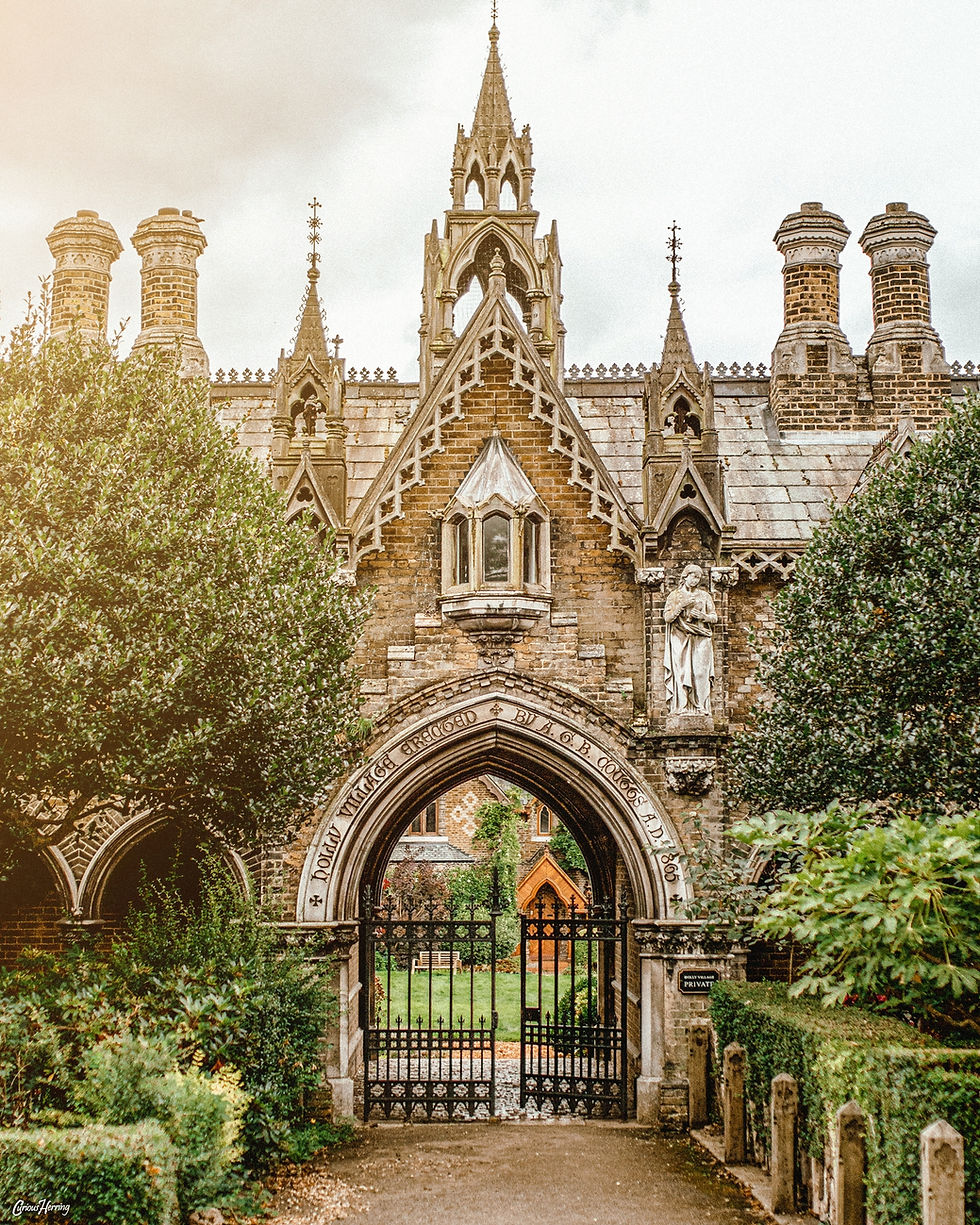
Its elaborate stone gateway interrupts an otherwise quiet stretch of Highgate, offering just enough of a view through the arches to make you stop. When I visited, the gates sat partly open, framing a glimpse of pointed roofs, carved stone and greenery beyond.
The Village Hidden Behind the Gates
Holly Village was commissioned by philanthropist Angela Burdett-Coutts and designed by architect Henry Darbishire in the 1860s. Built as a group of twelve homes, the development is one of Highgate's more unusual architectural curiosities.
Today, it remains private residential property, so it should be admired from the public entrance rather than explored inside. I'll admit, I hadn't realised this when I visited and ended up having a little mooch into the gardens. I'd recommend respecting the privacy of the residents if you do pass by, though.
The cottages encase a small central garden and feature beautiful vintage-esk street lamps and benches. Each cottage has been plucked straight from a fairytale. With arches, chimneys and intricate carved details, each building has its own character.
Holly Village completely changed my impression of London completely.
Perhaps that's because it represents the side of a city I naturally gravitate towards: old architecture, strange details and places that feel slightly detached from their surroundings. It isn't a grand London landmark, nor somewhere that requires hours to explore. You could quite easily walk past it in a matter of minutes. But I couldn't.
Honestly, I think of this place regularly, saddened by the fact I will probably never be able to live in a place so whimsical. And when I think of London, it's this small collection of Gothic cottages that comes back to me first. Followed thereafter by Highgate's even darker side.
The Graves of Highgate Cemetery
Beside Highgate's residential streets, woodland begins to gather around old stone walls. Behind them lies Highgate Cemetery, where ivy, trees and decades of weather have transformed part of the Victorian burial ground into something that feels almost reclaimed by nature.
If Holly Village feels like the beginning of a Gothic story, Highgate Cemetery feels like walking into its next chapter.
Opened in 1839, Highgate was one of the great Victorian cemeteries created around London as the city's population rapidly expanded. Today it is divided into East and West sections, each with a noticeably different character.

The East Cemetery feels comparatively open, while the West Cemetery is the side that stayed with me.
Here, paths disappear beneath trees and monuments emerge unexpectedly from the undergrowth. Gravestones lean at angles, roots push through the earth and ivy curls around stone that has been standing for well over a century. It isn't immaculate, and that's precisely what makes it beautiful.
Photographing Highgate Cemetery
Fortunately for photographers like myself, it is run by the Friends of Highgate Cemetery Trust as a non-profit organisation, meaning you can visit for a small cost. It's worth every penny because not only is it interesting, but this places is absolutely layered with detail.
The West Cemetery contains some of Highgate's most extraordinary architecture. The Egyptian Avenue leads between imposing columns towards the Circle of Lebanon, where tombs curve around an ancient cedar tree. Elsewhere are Gothic memorials, mausoleums and statues in varying states of age and decay.
Graves are covered in moss and vines, some so old that they've been eaten by the ground beneath them. It feels as though you're walking through a Tim Burton movie.
Highgate London on Pages & Screen
With its winding paths, overgrown graves and extraordinary Gothic architecture, it isn't surprising to know that Highgate Cemetery has found its way into quite a few books and films. Its darker side has been particularly well suited to British horror. Highgate appeared in Taste the Blood of Dracula in 1970, followed by Tales from the Crypt in 1972 and From Beyond the Grave in 1974.
More recently, the cemetery appeared in the 2009 adaptation of Dorian Gray, while Fantastic Beasts: The Crimes of Grindelwald transformed part of Highgate into Paris's Père Lachaise Cemetery.
Highgate also became part of the world of Robert Galbraith's The Ink Black Heart, while the cemetery also appears in the Young Bond novel Double or Die. Even John Galsworthy's Forsyte Saga makes reference to Highgate as the final resting place of members of the Forsyte family.
Famous Graves at Highgate Cemetery
Highgate is also the resting place of an extraordinary collection of familiar names. One of my favourite authors, Douglas Adams, is buried in the East Cemetery, alongside figures such as George Eliot and Karl Marx. Across in the West Cemetery you'll find scientist Michael Faraday, musician George Michael and Catherine Dickens, the wife of Charles Dickens, among many others.
Yet I found myself less interested in searching for famous names than in the thousands of unfamiliar ones surrounding them. Walking among so many lives reduced to names, dates and weathered inscriptions gives the cemetery a strange sense of scale. Some monuments are enormous; others are barely visible beneath moss and leaves. Many belong to people whose stories have long since disappeared from living memory.
There is sadness here, certainly, but I didn't find it purely morbid. If anything, being surrounded by so much evidence of lives that came before ours makes the world outside feel more immediate. For a short while, your own place in it feels incredibly small. And strangely, I find something comforting in that.

We are here for an impossibly brief amount of time, leaving behind photographs, names, stories and small pieces of ourselves in the people and places we encounter. Eventually those traces become part of everything that came before them.
Perhaps that's why Highgate affected me more than London's grander landmarks ever have.
Holly Village showed me the fairytale side of London I never believed existed, while Highgate Cemetery revealed something quieter: a place of stillness and beauty hidden within one of the busiest cities in the world.


Comments